






|
|
|||||
|
|
|
|
|
|
|
| Directed by Patricia Rozema |
| United Kingdom, 1999 (fiction, 112 minutes, colour, English) |
| Also known as "Kasvattitytön tarina", "Lettres de Mansfield Park", "Palácio das Ilusões" |
|
| Image: © patriciarozema.com |
|
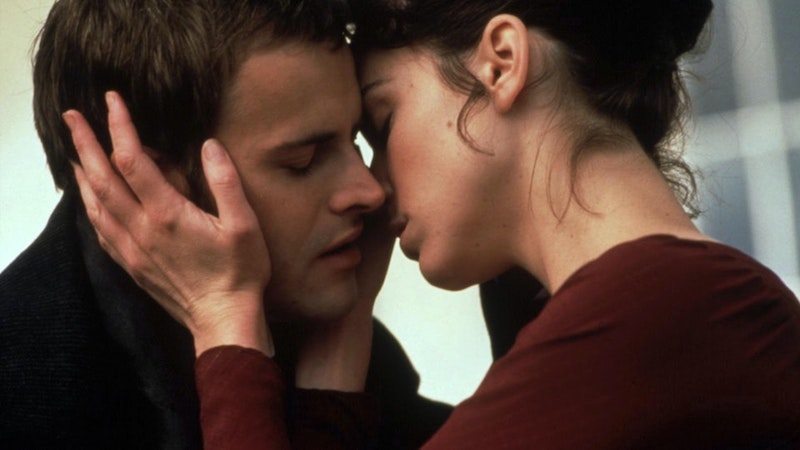
Film Description: "Patricia Rozema's daring adaptation of Mansfield Park is a witty look at romance and reality, Jane Austen style. Rozema has taken Jane Austen's third and most controversial novel and infused its lead character with irreverent and mischievous nature at the heart of Austen's own letters and early writings. The result is an original social satire with a strong-willed heroine at its center who à la Austen attempts to outsmart the dizzying labyrinth of marriage and social status—without compromising her ideals or her heart. This is the story of Fanny Price, who emerges from this comedic maze having discovered the rightness of one true love. [...]" -- patriciarozema.com (source) |
| Film Credits (partial): | |
| Written by: | Patricia Rozema |
| Based on: | Mansfield Park, a novel by Jane Austen |
| Produced by: | Sarah Curtis, David Aukin, Trea Hoving, Colin Leventhal, David M. Thompson, Bob Weinstein, Harvey Weinstein |
| Principal Cast: | Frances O'Connor, Jonny Lee Miller, Harold Pinter, Alessandro Nivola, Embeth Davidtz |
| Cinematography: | Michael Coulter |
| Film Editing: | Martin Walsh |
| Music: | Lesley Barber |
| Production Company: | Arts Council of England, BBC Films, HAL Films, Miramax Films, Miramax HAL Films |
"I selected this location [Kirby Hall] because I was keen to show something a little bit more grand and majestic, beautiful, but faded; its majesty was worn and torn. [...] Clearly they're a family hanging onto a glory that is waning, and I do believe that that was Austen's intent with Mansfield Park."
-- Patricia Rozema
(source)
"Maybe it's the remnants of my religious upbringing, but I do try and insert
a sense of social justice into the work ... for instance, to me,
Mansfield Park is a story about servitude and slavery. Other
people may have a problem with that, but that's how I read the book and so
that's how I shot the movie."
-- Patricia Rozema
(source)
"When I look back upon the choices I made in making Mansfield Park, I feel they were pretty ballsy. I just thought there has to be a reason why I was doing a period piece. I wanted to say, 'Look, we are rich because of slavery. We stole people and made them into slaves. Nothing comes for free.' I didn't want to do another English dance party."
-- Patricia Rozema
(source)
"You cannot underestimate what a radical thing it is to change from one art form to another. An author slaves to start with just the right word, phrase, sentence, and paragraph. The sounds of the words are crucial. But all the demands of words and prose are lifted when you make a movie. The physical presence makes many unnecessary and some necessary ones impossible. So you serve two masters as an adapting filmmaker: the author's intention and the needs of film. Sometimes 'fidelity' can mean only focusing on one day of a story told over twenty years in a book."
-- Patricia Rozema
(source)
"Si l'héroïne Fanny Price est devenue plus sympathique dans mon film, ce n'était pas dans le but d'accroître sa valeur commerciale, mais pour des raisons personnelles. Comme cinéaste, mon travail est d'apporter un nouveau regard. J'ai voulu montrer l'univers d'Austen dans ses aspects plus explicitement sexuels, passionnés, tragiques mais aussi burlesques en un monde marqué par l'esprit de caste."
-- Patricia Rozema
(source)
"Unlike other recent Austenian adaptations, Rozema's Mansfield Park
self-reflexively points to itself as intertext, as an intervention into
contemporary debates on Austen and authorship. Above all, it effectively
and openly acknowledges that the very process of adaptation is
necessarily founded on an act of reading and 'unfaithful' possession."
-- Mireia Aragay
(source)
"Widely considered Rozema's masterpiece for its originality in adaptation and deftness in direction, she collaborated on the film [Mansfield Park] with her partner Lesley Barber, who composed the musical soundtrack."
-- Kay Armatage
(source)
"By looking at Fanny/Austen in the text in connection with [Patricia] Rozema's comments about authorship and adaptation, we can reread the self-authorizing narrative of Mansfield Park as a self-authorizing narrative of the woman filmmaker as well."
-- Shelley Cobb
(source)
"Patricia Rozema's brilliantly tendentious film of Mansfield Park (1999)
reflects an awareness not only of postcolonial criticism that has implicated
the novel in issues of slavery but of gender criticism that has discovered
alternative sexual possibilities in her novels. Perhaps it is their
responsiveness to multiple ideological demands, rather than their achievement
of universal truths transcending culture and period, that makes her novels
classic."
-- Alistair M. Duckworth
(source)
"This [Mansfield Park] is an uncommonly intelligent film, smart and amusing too, and anyone
who thinks it is not faithful to Austen doesn't know the author but only her plots."
-- Roger Ebert
(source)
"[Patricia] Rozema redirects the focus of Mansfield Park, turning a novel concerned with
the effects of particular upbringings on individual happiness and morality
into a film concerned with the effects of broader social forces on the content
and discontent of entire classes of people, as well as their individual
representatives."
-- Sayre Greenfield, Linda Troost
(source)
"In Mansfield Park, Rozema's social critiques of slavery, colonialism, and
women's roles in society make it impossible to incorporate Austen's emphasis of stability, moral guidance, and community. In the adaptation, Rozema emboldens Fanny's character, inviting audience members to cheer Fanny's freedom from Sir Thomas's and Mansfield Park's imprisonment and their moral flaws. [...] While Rozema's film skews the preferred reading of Austen's novel toward a contemporary colonialism critique, Mansfield Park remains true to many aspects of Austen's work. The adaptation bases its interpretation and critique in the text; in other words, the interpretation is viable, although controversial."
-- Kathi Groenendyk
(source)
"Finally a director has taken real risks and reaped real rewards with [Jane Austen's] work, treating her novels not as a museum piece or as a sacred text but as a living presence whose power inspires flight. Mansfield Park is an audacious and perceptive cinematic evocation of Austen's distinctively sharp yet forgiving vision."
-- Claudia L. Johnson
(source)
"[In Mansfield Park Patricia] Rozema evicts Fanny's seafaring brother William from her feminist adaptation, developing instead the character of sister Susan. William's adventures are inserted as Fanny's own fantasies; drawn from the young Austen's diaries and narrated by Fanny, the adventurous impetus is reinscribed as part of a nascent feminist fantasy world."
-- Julianne Pidduck
(source)
"Given the recent spate of Jane Austen adaptations (notably, Ang Lee's Sense and Sensibility, Douglas McGrath's Emma and the BBC productions of Persuasion and Pride and Prejudice), one could be forgiven for anticipating diminishing returns from what is widely viewed as the author's least satisfying and most intractably moralistic work [Mansfield Park]. But that would be to reckon without the contribution of Canadian director Patricia Rozema who, disdaining a purist approach, offers some smart and suggestive variations on the usual Regency rituals."
-- Andy Richards
(source)
"A box-ofice disappointment after the string of Austen hits, Mansfield Park
represents the definitive internationalisation of the Austen franchise beyond
the British heritage aesthetics. It is also the most reflexive film in the
Austen cycle. In Mansfield Park, the stylisation of the mise-en-scène
articulates a discourse on the past that is divided between the reenactment of
the pleasures of the romance narrative, and their ironic rewriting."
-- Belén Vidal
(source)
"While outraged fans imagined Jane Austen rolling or spinning in her grave in response to Rozema's Mansfield Park, in many ways the film's emphasis on the slavery subtext in Austen's novel was simply the logical outcome of the revisionist historiography and literary criticism of the past twenty years or so that has placed the question of slavery at the center of discussion of early nineteenth-centry British history in general and of Austen's Mansfield Park in particular, and has placed this hitherto least appreciated of her novels at the center of the Jane Austen canon."
-- Tim Watson
(source)
"Itself a 'heritage piece', with all the accessories of the genre, beautiful cinematography, elegant costumes, sweeping panoramas, and the obligatory ball, the film [Mansfield Park] seeks to modify, perhaps contest, the genre from within."
-- John Wiltshire
(source)
"Au lieu de simplement mettre en images la trame du récit, la cinéaste torontoise a en effet choisi de modifier celle-ci en y intégrant des écrits de jeunesse de la romancière. Elle jette ainsi un éclairage nouveau sur l'oeuvre, mais surtout sur Jane Austen elle-même en faisant non seulement de l'héroïne de l'histoire une écrivaine, mais aussi l'alter ego de cette dernière."
-- Marc-André Lussier
(source)
"Une caméra souple, de belles images, des caractères bien dessinés : cette oeuvre à la fois grave et drôle, tournée sur plusieurs sites de Grande-Bretagne, est un excellent cru Austen, techniquement assez classique. La signature éclatée de la cinéaste du Chant des sirènes n'est pas toujours visible si ce n'est dans ce regard critique posé sur la belle société égoïste ici dépeinte."
-- Odile Tremblay
(source)
|
|
|
|
|
|
|